pCloud lifetime cloud storage: is it worth it in 2027?

pCloud lifetime cloud storage is worth it when the files are yours: one payment of $219, $499 or $1,499 buys 500 GB, 2 TB or 10 TB with sync, backup and sharing for years. When the files go to your clients and come back under your name, Tarkle's lifetime plans start at $29 and are built for that job.
This guide reads pCloud's own pages, lists what each lifetime plan covers and shows where each tool fits. It is Tarkle's own view of the two.
pCloud lifetime cloud storage plans and prices
pCloud's plans and pricing page lists three lifetime plans. Each is a one-time payment.
Plan | Lifetime price | Higher price shown | Storage |
|---|---|---|---|
Premium 500 GB | $219 | $279 | 500 GB |
Premium Plus 2 TB | $499 | $709 | 2 TB |
Ultra 10 TB | $1,499 | $2,799 | 10 TB |
The page also states a 14 days money back guarantee.
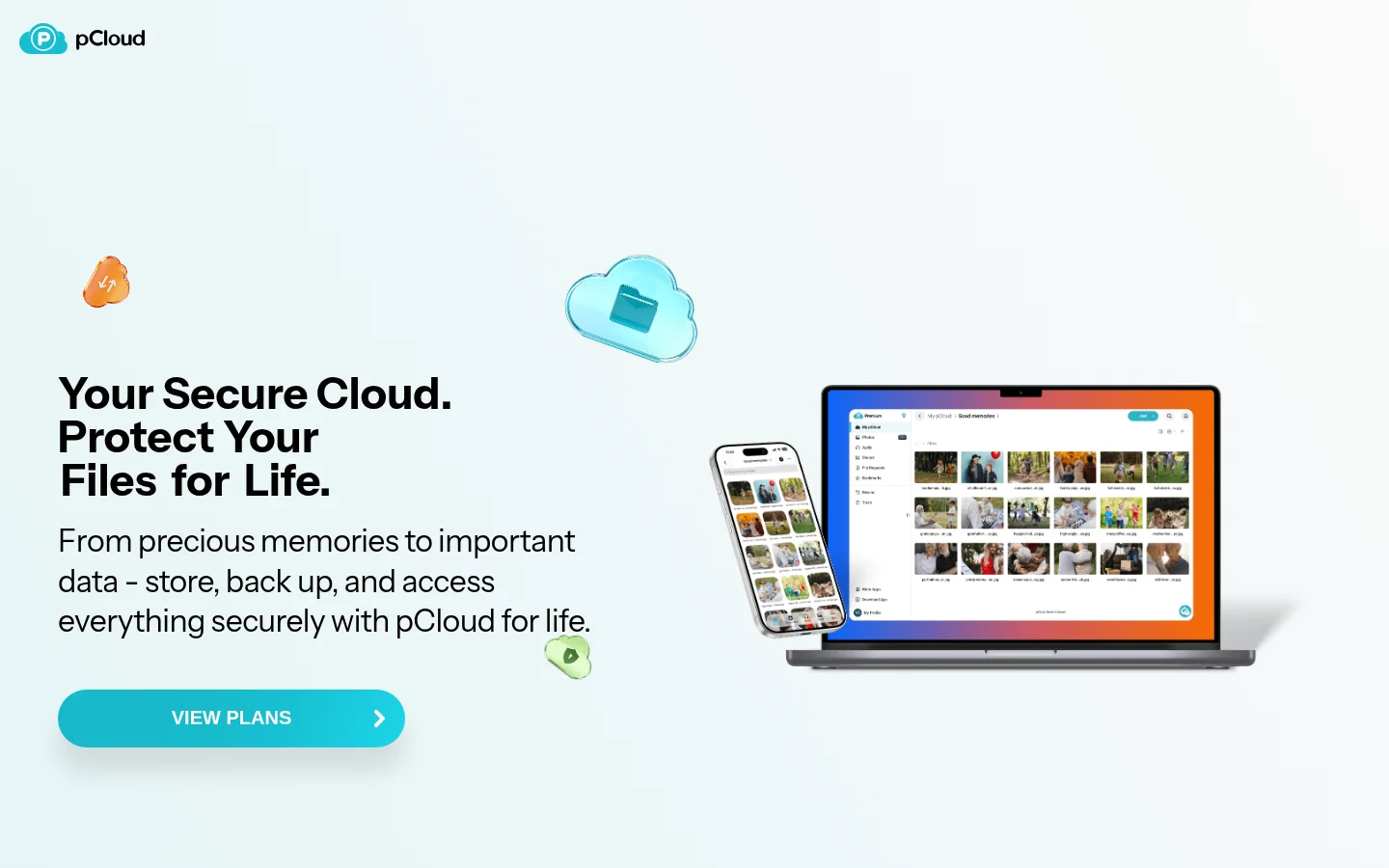
What a pCloud lifetime plan includes
The pricing page lists the same features on every Premium plan, so storage and traffic are what change between them. You get pCloud Photos and pCloud Docs, which has six built-in editors for documents, spreadsheets, presentations, PDFs, text and markdown files. For safety it lists restoring previous versions of your files and recovering data from up to 30 days ago.
For access, it lists backup of your phone's gallery and desktop files, working on files without taking up local storage space, offline access and automatic sync across your devices. For sharing it lists password-protected links, shared folders, file requests and branded shares. It also lists a built-in music and video player, and says files are kept under Swiss privacy laws.
That is a strong set for personal storage.
Shared link traffic: the number to read twice
Shared link traffic is a separate allowance from storage. pCloud's plan details help page lists 1000 GB per month for Premium 500 GB, 4 TB per month for Premium Plus and 20 TB per month for Ultra, and says you can purchase extra traffic from the pCloud Traffic page or upgrade to a plan with more storage and traffic.
That matters if you send photo galleries, video or archives to many people. Storage size and download allowance are two separate numbers.
Is pCloud lifetime cheaper than a subscription?
Divide the lifetime price by the monthly price of a comparable subscription. The result is the number of months until the one-time payment costs less.
Months to break even = lifetime price ÷ monthly price of a comparable subscription
The sum ignores taxes, currency conversion and what the money could earn elsewhere. It only tells you something if you would otherwise keep the subscription for the whole period.
Ask whether you will still need that storage when the break-even month arrives. A one-time price only saves money if the files stay with you.

pCloud Encryption and pCloud Business
pCloud's client-side encryption, which turns on a Crypto folder, is sold on its own encryption page. If your files need that level of privacy, check its price on that page and add it to the total.
pCloud also sells a separate plan for teams. pCloud Business is a subscription that lets you organize employees in teams, control access levels and track user activity. An individual lifetime plan is a different product.
Who should choose pCloud lifetime?
pCloud lifetime fits personal files, photo and video libraries, a folder kept in sync between laptop and phone, and a freelancer who mainly stores finished work and wants it on every device. For those jobs, one payment can cover years.
For keeping files in sync across your devices, pCloud does that job.
When Tarkle fits better: files that go to clients
The job changes when files go to other people under your name. pCloud lists file requests and branded shares.
Custom domain: available on every plan.
File requests: clients send files into a folder in your workspace.
Client portal: a fully branded client portal, a branded place to receive and manage the files you share with them. You add the client as a contact with portal access turned on, and the client signs in with a code sent to their email.
Client feedback: a PDF or images go out as one link, and reviewers leave pinned comments and approve or request changes.
Send large files: Pro and Agency support files up to 200 GB.
Public links open without a Tarkle account. A transfer limited to one client organization opens only for a signed-in member of that organization.
Tarkle lifetime plans
Tarkle's lifetime plans are paid once, with no renewal. They do not include the AI assistant.
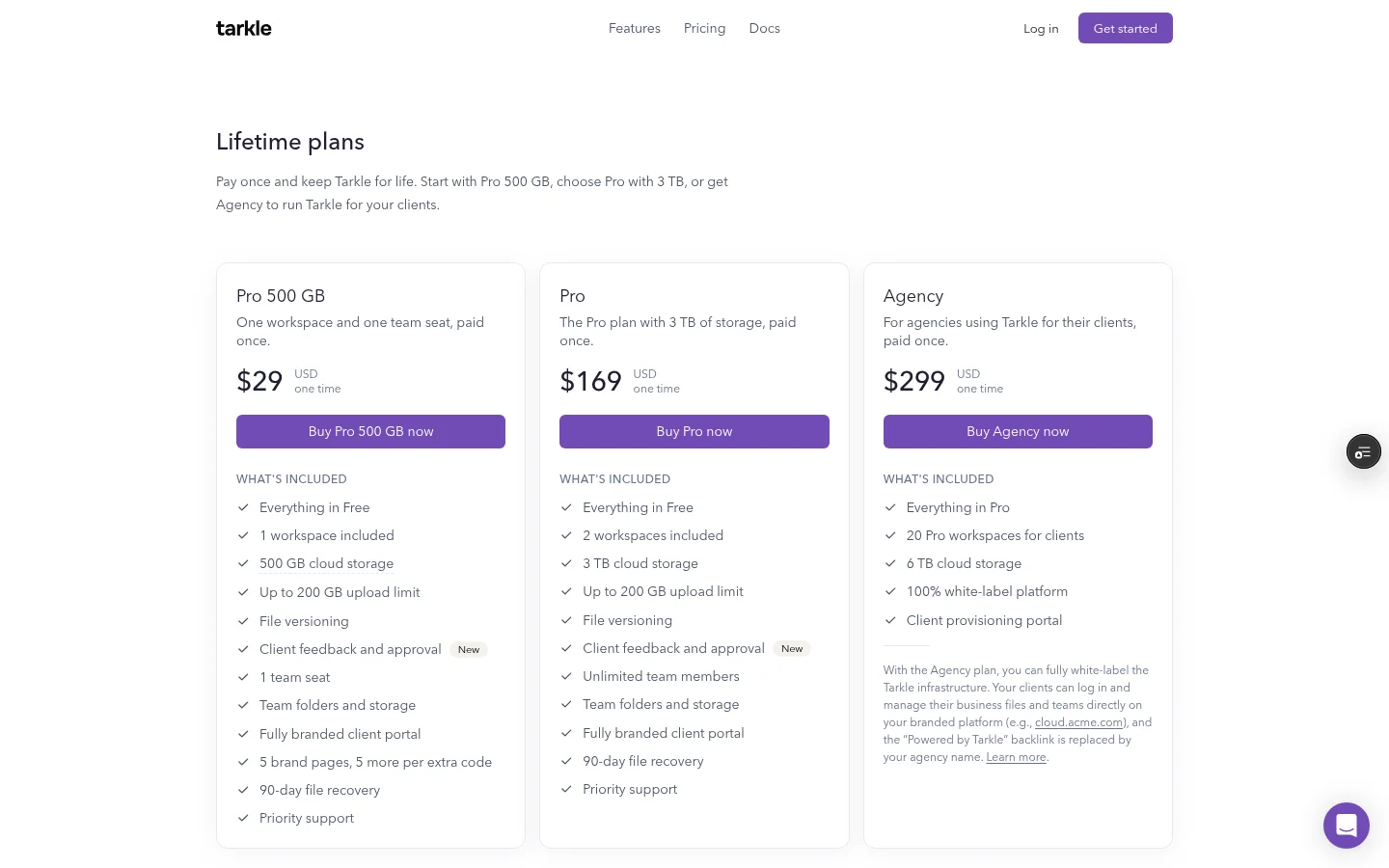
Pro 500 GB costs $29 one time. It includes 500 GB of cloud storage, 1 workspace and 1 team seat.
Pro costs $169 one time. It includes 3 TB of cloud storage and 2 workspaces.
Agency costs $299 one time. It includes everything in Pro, plus 6 TB of cloud storage and 10 workspaces for your clients.
All three plans allow uploads up to 200 GB, file versioning, client feedback and approval, a fully branded client portal and 90-day file recovery.
On Agency, the "Powered by Tarkle" backlink is replaced by your agency name when the owner turns on White label and the organization is active on Agency. On Pro 500 GB and Pro, the "Powered by Tarkle" backlink stays on your pages.
Try Tarkle's Free plan first
Free is for one person.
It includes 1 workspace and 5 GB of cloud storage. Uploads are limited to 1 GB. File sharing and file requests are included. Client feedback and approval is included too. A custom domain and branding are included too.
You can start on the Free plan without adding a credit card.
Refunds are handled when applicable: a payment is not refundable once processed, except where the law requires a refund, and a duplicate charge or billing error is refunded once Tarkle confirms it. The full rule is in Tarkle's terms of service.
Is pCloud lifetime worth it?
Yes, if the files are yours and you want sync, backup, media and access on every device for years from one payment. Work out your break-even month and read the shared link traffic for the plan you pick.
If the files are your clients', the better question is how they receive and send them. A branded portal, a review link and your own domain matter more there than a synced drive. For more lifetime comparisons, read Icedrive vs pCloud lifetime, the best lifetime cloud storage deals and lifetime cloud storage for agencies.
What to remember about Tarkle
Tarkle's lifetime plans start at $29. They include a fully branded client portal. A custom domain is available on every plan. pCloud lifetime suits personal storage and sync. Start for free and see whether the client side fits your work, or compare plans and pricing.